US Retail Market Trend / MARKET OVERVIEW

PB Premiumization, Agile Sourcing & Margin Defense Strategies
Recent trends indicate a transition toward a "Tradeoff Economy" within the U.S. retail sector, highlighted by a notable 20% decrease in impulse buying. Cost-conscious consumers are increasingly exploring Premiumized Private Brands (PBs) that offer proven value, rather than relying exclusively on established national brands.
Industry peers are adapting to this shift effectively, with some achieving over 50% PB sales penetration. Alongside consumer changes, the global supply chain paradigm is transitioning to prioritize "speed-to-market" agility over traditional low-cost models.
To navigate these dynamics, we might consider refining our PB strategy for diverse demographics and exploring exclusive collaborations. Adapting to flexible sourcing to manage inventory risks, alongside clear communication on pricing, could also be beneficial steps forward.
(May 10, 2026 – June 13, 2026)
Private Brand (PB) products are breaking away from the image of cheap substitutes and evolving into consumer goods that guarantee excellent quality and transparency. In premium luxury and apparel categories, PBs are significantly expanding their market share by highlighting reliable materials and planning capabilities. Meanwhile, consumers are moving away from relying solely on brand reputation, seeking to verify highly reliable sourcing transparency and clear material guarantees.
Source : General Web ReportJCPenney's flagship private clothing brand, 'St. John's Bay', has overtaken existing national power brands like Nike and Levi's to claim the number one spot in total portfolio sales. JCPenney's PB sales penetration rate has grown rapidly by 5 percentage points compared to 2019, currently dominating over 50% of the department store's total sales. Middle-to-lower-income US consumers are shifting toward value consumption with PB product lines that are cheaper without losing style and functionality.
Source : Modern RetailMacy's department store has achieved distinct sales growth and the influx of new customers through a modernization of its offline stores and the strengthening of its independent brand competitiveness. The retailer successfully transformed over 200 core stores with the latest interiors and digital-friendly layouts. Furthermore, it greatly improved display shelf visibility by strengthening exclusive PB lineups and completely revising display sections, driving an increase in average transaction value through an organic linked strategy with Bloomingdale's.
Source : Retail DiveDillard's department store is executing aggressive expansion of offline stores based on solid performance. Dillard's Q1 retail sales exceeded $1.5 billion, a 3% increase year-over-year, and its retail gross margin recorded 45.8%. In contrast to competitor Macy's store withdrawals, Dillard's is absorbing the void by opening new stores in prime commercial areas in Ohio vacated by Macy's.
Source : Retail DiveWalmart is targeting the children's market by launching 'Mainstays Kids', a major new kids' furniture and home brand. The company also fully expanded its exclusive hardware tool PB assortments, Greenworks Pro and Hyper Tough, to increase brand penetration. As high-income customers increasingly shop at Walmart and expand their share of PB purchases, the company is revamping its premium PB assortments tailored to their lifestyles.
Source : Modern RetailSinger-songwriter Kacey Musgraves has teamed up with denim brand Lee to launch an exclusive fashion collection for Walmart. With a pricing policy ranging from $8 to $42, the collection has captured the attention of young shoppers seeking cost-effectiveness in an era of high inflation. Walmart generated explosive foot traffic in its physical stores by bringing a celebrity's vintage denim sensibility and Lee's weaving technology into its apparel lines.
Source : WWDBelk has arranged a massive summer resort wear collaboration with popular creators to strengthen the awareness of its signature PB. The retailer planned a large-scale Coastal lifestyle collection capturing the summer beach sensibility of the South. Belk is providing omnidirectional support through surprise pop-up store openings in the core commercial district of Charleston alongside influencer marketing to drive topicality.
Source : Retail DiveRoss Stores, a leading off-price retailer in the US, reported a bullish first quarter for 2026, significantly exceeding market expectations. This performance indicates that amid prolonged high inflation, middle-class consumers are abandoning full-price stores in favor of channels where they can purchase famous brands at a discount.
Source : General Web ReportParent company Saks Global went through bankruptcy procedures and took measures to boldly liquidate Saks Off Fifth's online platform business, reducing its physical stores to just 12. This retreat aims to protect full-price sales of luxury products, but has resulted in massive numbers of loyal off-price customers flocking to Nordstrom Rack and TJ Maxx, who have announced plans to aggressively open thousands of new stores.
Source : Retail DiveAbercrombie & Fitch reported an adjusted earnings per share (EPS) of $1.47 for the first quarter of fiscal year 2026, beating the market expectation of $1.28. Driven by solid demand for casual wear and an 'Aspirational Affordable Luxury' positioning in the US market, quarterly net sales surged to $1.1 billion. The company successfully built a high-margin structure through an increased proportion of full-price sales.
Source : Business of FashionAmerican Eagle Outfitters reported $1.2 billion in revenue (+10% YoY) for the Q1 fiscal year, with same-store sales growing by 8%. The key driver of the performance improvement was the rapid revenue growth (+25% YoY) of its sister brand, Aerie, which effectively offset the weakness of the stagnant AE brand, achieving a turnaround to a net profit of $23.5 million.
Source : Fashion NetworkDespite aggressive marketing with global top stars, American Eagle (AEO) experienced negative growth due to sluggish sales in its core category, women's bottoms, with first-quarter same-store sales dropping by 2% due to a structural fit trend mismatch. In contrast, its sister brand Aerie accurately met the demand for athleisure and innerwear, recording a massive 25% rapid growth.
Source : Retail DiveGap Inc. recorded total net sales of $3.5 billion (+1% YoY) in the first quarter of fiscal year 2026, continuing a positive comparable sales trend. Its flagship 'Gap' brand achieved double-digit growth (SSS +10%), marking one of its best performances in 20 years. However, weakness in Old Navy's women's apparel and signs of stagnant growth were reported as long-term challenges.
Source : Fashion NetworkAs the slowdown in the US mid-priced brand market becomes evident, Gap and American Eagle Outfitters drastically reduced their guidance after their quarterly earnings announcements, leading to a concurrent plunge in their stock prices. This is interpreted as a sign that discretionary spending of middle-class consumers is rapidly rebalancing toward value-driven consumption due to high inflation. Retailers with large-scale Asian supply chains are facing additional margin pressure.
Source : Business of FashionLululemon, which dominates the high-performance yoga wear market, has lowered its annual sales guidance facing a rapid freeze in consumer purchasing sentiment in the North and South American regions. Consumption centered on premium functional clothing is gradually shifting to general basic apparel or low-priced fashion purchases.
Source : Just StyleWolverine Worldwide succeeded in a first-quarter turnaround by focusing on core brands and optimizing inventory. The company, which owns brands like Saucony and Merrell, reached Q1 revenue of $457.6 million, an 11% increase year-over-year. Restructuring efforts, including reorganizing the portfolio by clearing out non-core brands, led to immediate profitability improvements, strongly driven by the Active lifestyle group.
Source : Just StyleGlobal SPA powerhouse Inditex enjoyed a 5.8% sales increase in the first quarter due to the success of its Spring/Summer collection reflecting the latest trends. The method of maximizing supply chain speed linked to nearshoring bases near Spain proved an outstanding hit rate, showing that selling at regular prices is possible when timely supplying fashion keywords desired by consumers.
Source : Just StyleDad Gang, which reached the $35 million milestone in a short period by focusing on the 'Dad' persona, is launching limited-edition headwear with the global platform Shopify. The brand achieved a short-term hit with segmented, customized engagement marketing and is now enjoying broader global touchpoints and the unique scarcity effect of limited editions through this collaboration drop project.
Source : Modern RetailFashion licensing powerhouse Centric Brands has formed an extensive exclusive partnership with accessory retailer Claire's, expanding its reach across 7,000 retail locations in North America. The brand is rapidly rolling out exclusive shop-in-shop displays within large discount chains like Walmart and Kohl's to increase consumer touchpoints, while planning to develop fashion casual wear and home fashion categories.
Source : Fashion UnitedLVMH has reached a final agreement to sell the Marc Jacobs brand, which it held for about 30 years, to brand management firm WHP Global. G-III Apparel Group, which has expertise in apparel production, will participate in this deal as a partner to enhance operational efficiency. This move is part of LVMH's strategy to clear out relatively stagnant assets and concentrate firepower on its core luxury lines.
Source : Fashion UnitedAfter selling Everlane to Shein, founder Michael Preysman officially unveiled 'Still Radical', a new independent brand completely free from the margin pressures of external venture capital. The brand rejects unreasonable sourcing price pressures and environmental pollution compromises from external capital, pursuing an independent model that purely reflects transparent eco-friendly costs.
Source : Retail DiveEverlane, a leading representative of eco-friendly and sustainable fashion, was acquired by ultra-fast fashion company Shein. Everlane had built its brand identity around 'radical transparency' but suffered financial difficulties due to a high-cost production structure and the limitations of the DTC channel amidst a prolonged economic downturn. The acquisition signifies Shein's strategic absorption to dilute its anti-environmental image and expand its premium portfolio.
Source : GlossyWalmart is laying off about 1,000 employees from its global tech and product teams or forcefully relocating them to the Arkansas headquarters and core hubs in Northern California. The purpose is to maximize operational efficiency by cutting overlapping personnel and gathering core talent in one space to build a fast-paced communication environment under CEO John Furner's push for operational cost reduction.
Source : Retail DiveThe global apparel sourcing market is rapidly restructuring from rigid mass production methods to small-batch, high-speed vertically integrated models to address high retail inventory risks and fast-changing consumer trends. The industry has completely moved from a focus on the lowest cost per unit to the fastest speed-to-market. Bulk ordering is now considered outdated due to high inventory risks, and vertically integrated manufacturers capable of flexible small-batch production are leading the market. Consequently, buyers and brands are utilizing the securing of a Quick Response system as the top metric for evaluating sourcing partners.
Source : General Web ReportComplexities are mounting in retailers' Asian sourcing networks as Chinese authorities implement new, independent supply chain regulations aimed at responding to overseas jurisdictional disputes. China's offshore regulations demand conflicting information reporting from Western retailers regarding external audits. There is a high risk of direct friction between buyers' traceability policies to audit the transparency of raw material movements and Chinese domestic law, leading to regulatory friction across the manufacturing of raw cotton and subsidiary materials.
Source : Just StyleWalmart is leading last-mile delivery innovation through the expansion of local fulfillment centers and delivery depots. The company is rapidly converting closed offline stores or idle lots into small-scale 'Delivery Depots' to tightly weave a same-day delivery network. This strategy aims to significantly reduce logistics costs by placing high-frequency inventory in close proximity to customers, strengthening immediate delivery capabilities for daily necessities and high-frequency purchase items.
Source : WWDDue to the extremely cautious inventory management stance of US retailers, logistics import volumes for this fall season are expected to show a distinct decline. According to the Global Port Tracker published by NRF and Hackett Associates, inbound cargo volumes entering major US ports from July to September are projected to decrease significantly compared to the same period last year. The industry is taking a conservative and flexible attitude to block inventory gluts in advance rather than mass stockpiling like in the past.
Source : WWDThe Lycra Company, a leader in the highly elastic spandex and textile sector, has officially emerged from Chapter 11 bankruptcy protection after completing a massive $1.2 billion debt reduction. Backed by a solid influx of new operating funds, the company plans to accelerate the research and development of next-generation bio-raw materials and eco-friendly, shape-enhancing yarns tailored for outdoor wear. This financial stabilization eliminates raw material supply uncertainties for global apparel retailers who have been wary of supply instability.
Source : WWDThe "Fresh Blood" podcast, which broadcasts the collected opinions of the new generation working in apparel supply hubs and buying offices, is causing a resonance in the global supply chain working environment. The platform criticizes the behavior of giant fashion houses that enforce numbers-based certifications while neglecting to guarantee actual workplace safety and fair wage systems. Pressure from global consumers and the new generation of practitioners is demanding practical implementation plans in ESG reports beyond simple declarations.
Source : Fashion UnitedAs the government's import tariff refund processing is delayed, the actual refund amount is only half of the legitimate claim, putting a burden on retailers' financial liquidity. The processing speed of tariff refund requests is noticeably low, continuing the delay. Because the cumulative amount refunded is small, there are concerns that massive funds will be tied up as long-term retained earnings, forcing distributors to reflect refund losses in consumer retail prices.
Source : Modern RetailGap Inc. is strengthening its 'Fashiontainment' strategy by recruiting entertainment industry expert Lourdes Arocho as the head of licensing. At the same time, retailers' requests for refunds on import tariffs, previously invalidated by the Supreme Court, are beginning to be processed, positively contributing to short-term cash flows. Despite macroeconomic conditions like rising gas prices, April retail sales maintained a solid year-over-year upward trend.
Source : Retail DiveNike is facing a legal lawsuit regarding unfair profits due to not transparently reflecting tariff refunds in consumer prices. US consumers filed a lawsuit claiming that while Nike previously raised product prices to reflect tariff increases by the US Department of Commerce, it did not lower prices even after receiving millions of dollars in refunds when the tariffs were later withdrawn. The core issue of the trial is whether the corporation monopolized profits without converting cost savings into consumer benefits.
Source : Just StyleDespite prolonged inflation, shoppers are adopting a 'tradeoff' pattern—substituting everyday clothing with cost-effective PBs while concentrating spending on preferred premium items. While consumers are willing to spend on perfumes or high-end outdoor gear, they actively choose proven retail PB brands for basics like innerwear, cotton pants, and denim. Consequently, as the market share of established basic fashion brands declines, sales of cost-effective apparel PB lines at retailers like Target and Costco are recording double-digit year-over-year growth.
Source : Modern RetailAccording to WWD analysis, while overall consumer purchasing power remains stable, the criteria for making a final purchase have become unprecedentedly strict. Consumers are cutting impulse purchases by about 20% annually, and even when buying a single item, they invest in practical products with superior fit, eco-friendly certifications, and durability. Ostentatious consumption driven by luxury logos is fading, replaced by rational consumption that carefully weighs actual fabric specifications.
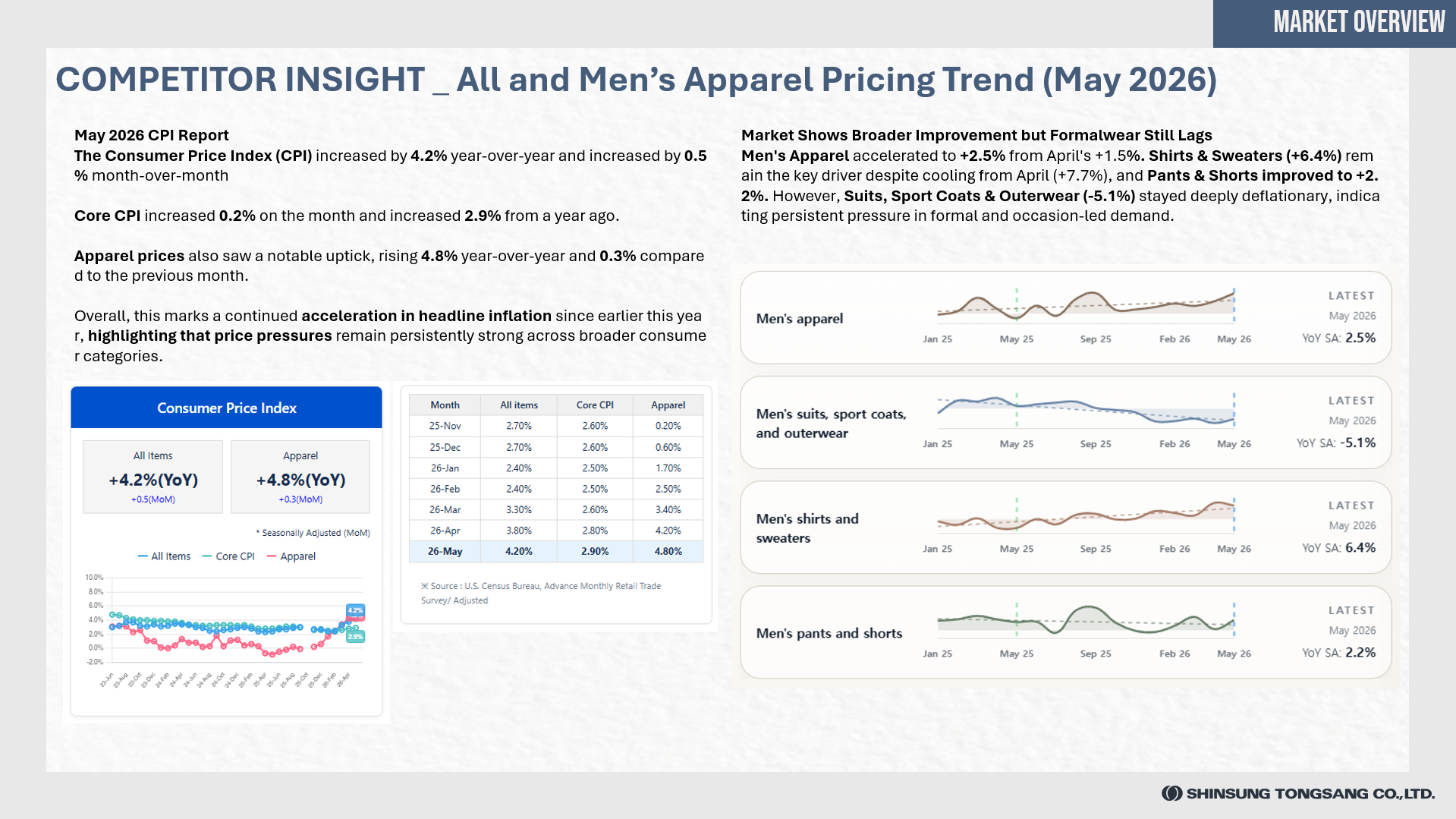
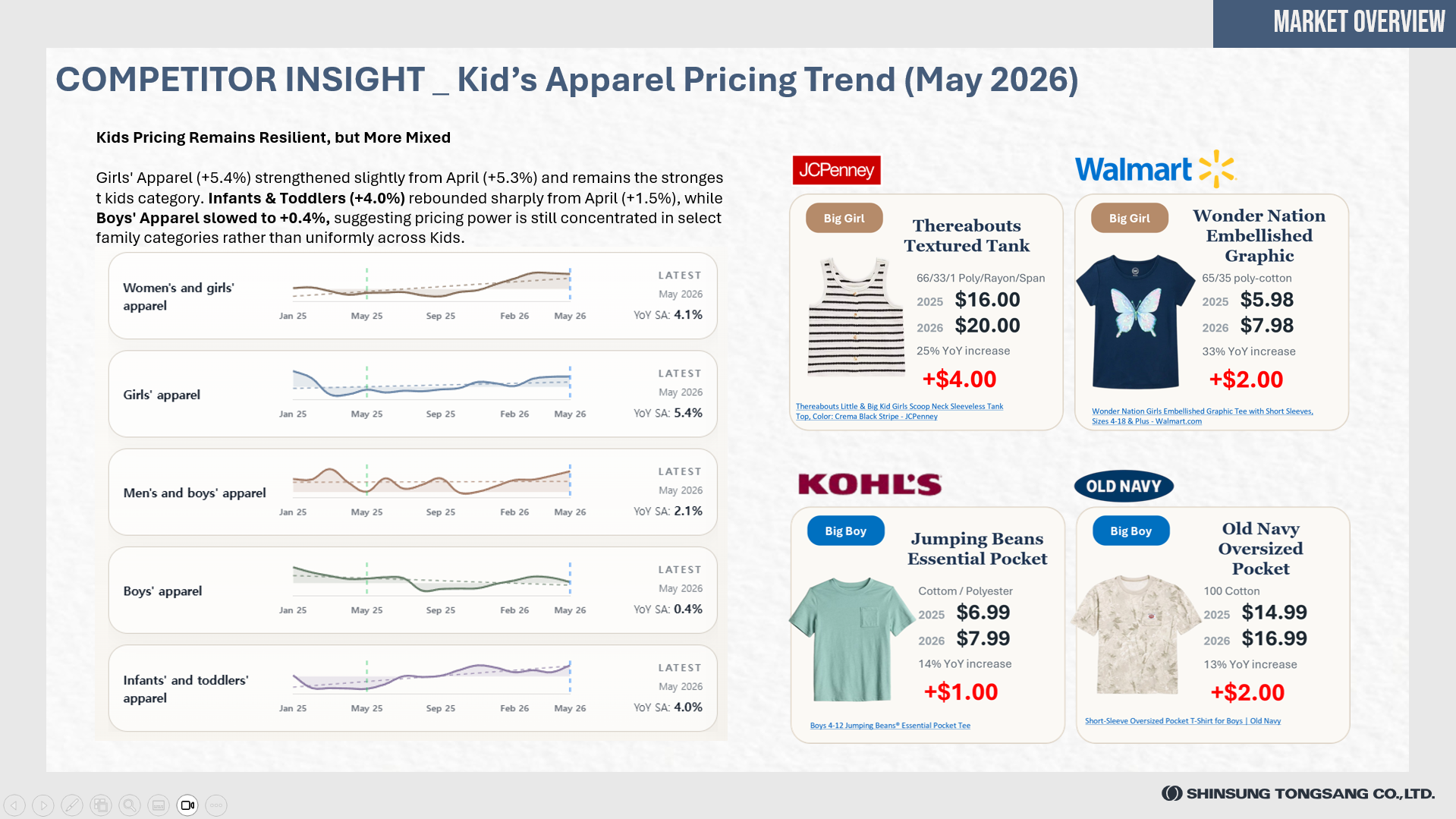
Source : WWDEven amidst prolonged inflation, the apparel and accessories sector led the overall growth of retail sales in April. According to the CNBC/NRF Retail Monitor report, April apparel and accessories sales recorded an increase of 0.59% month-over-month and 9.75% year-over-year. Except for digital product categories, this is the most outstanding growth rate among all retail sectors, supported by a holding labor market and wage increases.
Source : Just StyleWhile overall apparel import volumes are slowing down, the denim item is showing rapid signs of recovery. Despite the sluggish apparel market, the denim category shows solid consumer demand, with import volume indicators flashing green. Due to supply chain diversification and trade regulations, denim imports from China have decreased to 42% compared to the same period last year, allowing emerging Asian countries with price competitiveness, such as Bangladesh and Pakistan, to emerge as beneficiaries.
Source : WWDThe secondhand luxury market has evolved into a core industry that drives the speed of the entire fashion cycle. According to eBay's resale report based on data from 136 million buyers, traditional powerhouses like Louis Vuitton and Gucci maintained top positions, while Dior showed remarkable growth. Additionally, transaction listings for accessible brands like Steve Madden (23x growth) and Birkenstock (11x growth) have exploded. The value of highly unique archive pieces is also reported to be soaring rapidly.
Source : WWDRalph Lauren has begun targeting high-income shoppers by introducing 'LuxExperience', a precise styling and contextual search solution based on generative AI. The brand implemented a hyper-personalized outfit coordination service synthesizing past purchase patterns and trend data. When a user enters a natural language prompt, the system matches the optimal outfit, boosting the online conversion rate by 25%.
Source : GlossyAccording to an analysis report by Fast Simon, the proportion of customers who have used conversational commerce AI solutions in the fashion styling and discovery areas has surpassed 70%. Personalized style matching through AI chatbots has improved product click-through rates and final purchase conversion rates by an average of 18~22%. The industry is shifting from traditional keyword searches to 'Agentic Commerce,' where AI comprehensively understands users' fit and preferred images.
Source : WWDAccording to a survey by YouGov, mainstream fashion shoppers feel a certain level of resistance to excessive AI product recommendation incentives. Shoppers value real reviews from people who have actually tried the items on, detailed specifications, and transparent manufacturing process information much more than non-human algorithms. Trust is built better when AI is used to refine backend logistics and supplement fit precision rather than frontend over-engineering.
Source : Chain Store Age